Mobile home planning permission in Europe: rules country by country
In most European countries a mobile home installed to stay needs a planning licence or at least a prior communication or responsible declaration — being removable does not exempt it, and on a licensed park what the park's licence covers depends on the country (in Spain the campsite's activity licence does not cover the installation, STS 1917/2024). Rules vary by country and municipality, so always check before buying the plot: in Portugal it takes a licence or a prior communication (comunicação prévia) under the RJUE, depending on the PDM, and since 1 October 2026 a prior communication takes effect on submission and payment of the fees. Green Village sells new and used mobile homes with a published delivered price — used homes from £6,667 — and each listing gives the unit's dimensions for that check.
Planning permission is the most misunderstood aspect of buying a mobile home. A mobile home on a chassis escapes the rules for buildings only while it remains a vehicle; once it is installed to stay — on supports, connected to utilities, lived in — most European countries apply their general planning regime to it. "Removable" does not mean "no rules": each country, and often each municipality, has its own requirements that must be checked before investing.
This guide details the planning rules in seven European countries where Green Village operates, with practical examples, timelines and costs. The aim is clear: that you know exactly what you need to deal with before buying the plot and the unit.
General principle: removable vs fixed construction
Across Europe, planning legislation distinguishes between fixed construction (a building attached to the ground by permanent foundations) and a removable structure (one that can be moved without destruction). But a mobile home on a chassis escapes the rules for buildings only while it remains a vehicle (France: an RML on a campsite; United Kingdom: a caravan). Once it is installed to stay — on supports, connected to utilities, used as a dwelling — Portugal, Spain, Germany and the Netherlands apply their general planning regime to it; a removable foundation makes the installation easier to reverse and the unit easier to resell, but it does not exempt it from prior control.
The distinction depends on two factors: (1) the type of foundation (removable vs permanent) and (2) the connection to the ground (reversible vs irreversible). If the unit sits on concrete blocks or metal jack stands (removable), it retains its removable status. If it sits on a concrete slab or has buried foundations, it may be reclassified as fixed construction — with all the implications for planning permission, taxes and resale value.
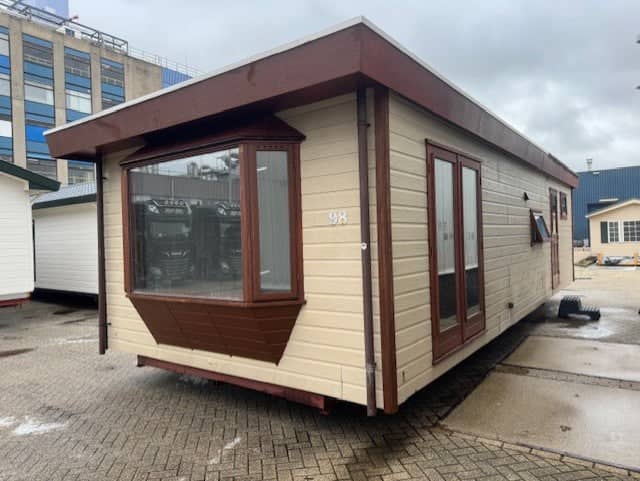
Units available now



Portugal
In Portugal, the installation of removable structures is regulated by the Regime Juridico da Urbanizacao e Edificacao (RJUE, DL 555/99) and by the Plano Director Municipal (PDM) of each municipality. The rules vary significantly from municipality to municipality — what works in the Alentejo may not work in Lisbon.
- Regime — article 1-A of the RJUE was repealed on 1 October 2026 (Decree-Law 108/2026, art. 10). The RJUE treats as a «building» (edificação) any construction incorporated into the land with a permanent character, regardless of the construction system (art. 2(a)); whether your installation fits that definition is decided case by case by the câmara municipal — request an informação prévia (art. 14). Construction works follow a comunicação prévia in areas covered by a detailed plan (plano de pormenor), execution unit or allotment that fixes the parameters, or in a consolidated urban zone under the conditions of art. 4(4)(e); otherwise, a licença (art. 4(2)(c)).
- Prior communication — applies where the planning parameters are already defined (allotment, plano de pormenor, consolidated urban area). Since 1 October 2026 it takes effect once it is correctly submitted, the fees are paid (self-assessment, minimum deadline of 60 days) and the start of works is notified — there is no 20-day deadline and no tacit approval; the council checks afterwards for 1 year.
- Licence — in all other cases; a decision within 20 days (buildings) after a 20-day saneamento (preliminary review) phase; if no decision is issued, it counts as tacit approval (deferimento tácito). Only the works of minor planning relevance in art. 6.º-A (e.g. annexes up to 10 m² and 2.2 m high) and those added by the municipal regulation are exempt.
- Urban vs rural land — the PDM decides: on rural land only where the land-use class is compatible (rural tourism, camping, tourist development); on RAN (National Agricultural Reserve) and REN (National Ecological Reserve) land construction works are prohibited except for the uses listed in article 22 of Decree-Law 73/2009 and the compatible uses in annex II of Decree-Law 166/2008 (article 20); in protected areas, also check the restrictions that apply. Always ask the council for written prior information before buying the plot.
- Holiday rental (AL) — for tourism use, an AL (alojamento local) registration is needed in addition to the planning title for the installation.
- IMI (municipal property tax) — while it is not entered in the matriz predial (property tax register), a mobile home pays no IMI. But the CIMI (art. 2.º, n.os 2 and 3) treats as a prédio (property) constructions "even if movable by nature" used for non-transitory purposes, and presumes permanence once they have stood in the same place for more than a year — a mobile home lived in permanently can be registered and taxed.
France
France has the most detailed regulations in Europe for mobile homes, reflecting the enormous French market (2+ million units installed):
- Mobile home on a campsite/PRL — no individual authorisation needed; the campsite or PRL holds the overall licence. The unit owner pays a pitch fee.
- Mobile home on private land — the legislation is restrictive. A "residence mobile de loisirs" (RML) is prohibited on private land whatever the duration, even on buildable land, unless its wheels and towbar are removed. Once removed, the unit becomes a construction: a declaration prealable de travaux (up to 20 m² footprint) or a permis de construire (over 20 m²) is required; on non-buildable land it remains prohibited regardless of duration.
- HLL (habitation legere de loisirs) — a broader category that includes mobile homes, chalets and capsules. An HLL can be installed on campsite, PRL or "pastilles" (zones under the national urbanisme regulations) with authorisation.
- Width: most mobile homes in France are 3.0–4.0 m wide — moving one privately is a specialist job; with Green Village, delivery is included in the price.
Spain
In Spain, planning regulation falls under the competence of the Autonomous Communities (CCAA), which creates significant differences by region:
- Andalusia — the most popular community for mobile homes. The land planning legislation (LOUA) regulates temporary structures on rural land, but since the STS 1917/2024 ruling installing a mobile home also requires a municipal urban planning licence, not just a minor works licence. Plots with a "proyecto de actuación" (development project) make the process easier, not unnecessary.
- Catalonia — more restrictive regulations. Mobile homes on classified campsites need the campsite's urban planning licence to expressly cover their installation (the campsite's activity licence is not enough, STS 1917/2024); on private land, they depend on the municipal urban plan.
- Valencian Community (Costa Blanca) — strong demand for mobile homes on campsites and in tourist zones, but since STS 1917/2024 a specific urban planning licence is required here too, not just the campsite's licence. Rural plots also require a responsible declaration.
- General — the ayuntamiento (town hall) is the reference authority. Since STS 1917/2024, the typical process is: prior consultation with the ayuntamiento → urban planning licence (treated like that of a prefab house, not a simple minor works licence) → installation. Timeline: 1–3 months, longer if the ayuntamiento requires a technical project.
Netherlands
The Netherlands has a rigorous but well-organised planning system:
- Recreatieparken — the simplest route: the park holds the permits and the use is recreational. Permanent habitation (hoofdverblijf) of a recreation home is prohibited unless the omgevingsplan allows it or the gemeente grants a persoons- or object-bound omgevingsvergunning — check with the gemeente.
- Own plot zoned residential (woonbestemming) — a chalet used as a dwelling needs an omgevingsvergunning for the omgevingsplanactiviteit from the gemeente; the technical build is notified under the Wet kwaliteitsborging.
- Own plot zoned recreation — a ground-level recreatiewoning that fits the omgevingsplan can be vergunningvrij for the omgevingsplanactiviteit, but the technical build remains subject to notification. Agricultural land needs a plan change.
- Woonwagenstandplaatsen — municipal pitches reserved for woonwagenbewoners under the gemeente's standplaatsenbeleid. Not a route for an imported chalet.
- Omgevingsplan — since the Omgevingswet (1 January 2024) the gemeente's omgevingsplan (formerly bestemmingsplan) determines the permitted land use; check via the Omgevingsloket before buying. The regular procedure takes 8 weeks, extendable once by 6; fees (leges) are a percentage of the building cost, set per gemeente.
Germany
In Germany, the regulations vary by Bundesland (federal state), but the principle is similar:
- Own land — a Mobilheim that stays in place and is connected to utilities is a bauliche Anlage (building), not a "fliegender Bau", so a Baugenehmigung is required in practically all Länder when it is used as a dwelling. Verfahrensfrei (permit-exempt) thresholds cover only tiny buildings and never mean "allowed": the Bebauungsplan or the built-up-area rule must still permit residential use.
- Ferienpark / Campingplatz — the simplest route: Mobilheime on an approved camping or weekend site are verfahrensfrei under most Landesbauordnungen, within the site's own approval and the Land's Campingplatzverordnung. Popular areas: North Sea, Baltic, Black Forest, Bavaria.
- Bebauungsplan (B-Plan) — the local building plan determines what may be built in each zone. Without a B-Plan, section 35 of the BauGB (outer area) applies — which is more restrictive.
- Dauerwohnen — campsites are "Sondergebiete, die der Erholung dienen" (§10 BauNVO), so using a Mobilheim as a main residence (Hauptwohnsitz) is not permitted under planning law unless the Bebauungsplan expressly allows it, which is rare. Registering an address (Melderecht) is possible but does not legalise the use.
- Permitting timeline and fees vary by Bauamt and Land: there is no fixed national timeline, and fees are charged on the building value under the Land's Gebührenordnung.
Italy
Italy has a decentralised system with regulation at regional and municipal level:
- Case mobili on campeggi — the simplest framework. The campsite holds the licence; the mobile home is installed as an accommodation unit.
- Private land — requires a permesso di costruire or SCIA (Segnalazione Certificata di Inizio Attivita), depending on the comune and the size. Only a temporary installation (up to 180 days, art. 6(1)(e-bis) of DPR 380/2001, with notice to the comune) counts as edilizia libera; a mobile home used as a permanent dwelling is new construction (art. 3(1)(e.5)) and needs a permesso di costruire, except on authorised open-air tourist sites.
- Piano Regolatore Generale (PRG) — the local regulatory plan defines land uses. Check with the comune.
- Tourist zones (Tuscany, Puglia, Sardinia) — greater acceptance of mobile homes and glamping.
United Kingdom
The UK has the most mature legislation for mobile homes (park homes):
- Residential park homes — site licence under the Caravan Sites and Control of Development Act 1960, with residents' rights under the Mobile Homes Act 1983 as amended by the Mobile Homes Act 2013. Residential parks are licensed by the local council and offer strong legal protection to residents.
- Holiday parks — holiday caravans on regulated parks. Use restricted to defined periods (typically 10–11 months per year).
- Garden of your own house — a static caravan within the curtilage of a dwellinghouse, used as extra accommodation for the same household (ancillary use), needs neither planning permission nor a site licence. Used as an independent dwelling or let out, it becomes a material change of use requiring planning permission; a Lawful Development Certificate gives certainty.
- Bare, agricultural or separate land — planning permission for use as a caravan site plus a council site licence. The statutory period is 8 weeks for householder or minor applications in England (13 weeks for major applications); fees from 1 April 2025 are GBP528 for a householder application and GBP588 for a change of use of land.
- The UK is relevant as the source of units (rather than the destination) for most Green Village customers.
Comparative planning permission table
Summary of the planning process by country:
| Country | Typical process | Timeline | Fee cost | Difficulty |
|---|---|---|---|---|
| Portugal | Licence or prior communication (RJUE, art. 4.º) depending on the PDM | Prior communication: effective on submission + fees; licence: decision in 20–45 days after saneamento | Municipal fees (set by each council regulation) | Low to medium |
| France | Declaration prealable or permis de construire | 1–2 months | EUR0–EUR400 | Medium |
| Spain | Urban planning licence (treated like a prefab house, STS 1917/2024) | 1–3 months | EUR100–EUR600 | Medium |
| Netherlands | Omgevingsvergunning (omgevingsplanactiviteit) from the gemeente; vergunningvrij only as an outbuilding in the rear garden or a small recreatiewoning on recreation land | 8 weeks (+6) regular procedure | Municipal leges (% of building cost) | Medium to high |
| Germany | Baugenehmigung on own land (§§30/34 BauGB; §35 Außenbereich practically excluded); verfahrensfrei on an approved Campingplatz | Varies by Bauamt (months) | On the building value (Land Gebührenordnung) | High |
| Italy | Permesso di costruire / SCIA | 1–4 months | EUR100–EUR800 | Medium |
| United Kingdom | None in your own garden as an annexe to the house; planning permission + site licence on separate land | 8 weeks (statutory, England) | GBP528 householder / GBP588 change of use (England, 2025) | Medium |
Common planning mistakes
The most frequent mistakes — and how to avoid them:
- Buying land without checking the PDM/omgevingsplan/B-Plan — the plot may not allow removable structures. ALWAYS check before investing.
- Installing without communication/licence — can result in a demolition order and fines. Even if the neighbour "also has one", legalise.
- Placing permanent foundations under a mobile home — reclassifies the unit as fixed construction, requiring heavier planning permission and subjecting it to IMI/taxe fonciere/IBI.
- Assuming "removable = no rules" — being removable does not exempt the installation. A licence, prior communication or responsible declaration is almost always required.
- Not considering protected zones (REN/RAN/Natura 2000/ZNIEFF) — much more severe restrictions, sometimes incompatible with any installation.
In summary
- Removable does not mean permit-free: installed to stay, a mobile home falls under the general planning regime; on a licensed park, confirm what the park's licence covers (in Spain it does not replace the municipal licence, STS 1917/2024).
- The process varies greatly by country and municipality — ALWAYS check before buying the plot.
- Portugal: licence or prior communication under the RJUE, depending on the PDM; since 1 October 2026 a prior communication takes effect on submission and payment of the fees.
- France: detailed regulation — campsite/PRL is straightforward; private land is more restrictive.
- Permanent foundations reclassify the unit as fixed construction — avoid if you want to keep the removable status.
- Green Village sells and delivers the unit; the planning licence is requested from the municipality (in Portugal, the câmara municipal).
Frequently asked questions
Do I need a licence to install a mobile home?
In most European countries, yes — a planning licence or at least a prior communication or responsible declaration; being removable does not exempt the installation. On a licensed park, what the park's licence covers depends on the country — in Portugal the unit is one of the park's complementary accommodation installations (Portaria n.º 1320/2008, art. 19.º); in Spain the park's licence does not replace the municipal licence (STS 1917/2024).
How long does planning permission take?
From 1 to 6 months, depending on the country and complexity. In Portugal, since 1 October 2026 a prior communication (comunicação prévia) takes effect on submission and payment of the fees, with no 20-day deadline; where a licence is required, the council decides within 20 days after the saneamento phase, and a missed deadline counts as tacit approval (deferimento tácito). In the Netherlands the regular omgevingsvergunning procedure is 8 weeks, extendable once by 6 (Omgevingswet); in Germany it depends on the Bauamt and the Land, typically a few months; in England the statutory period is 8 weeks for householder and minor applications.
Can I install a mobile home on rural land?
It depends on the PDM: only if the land-use class admits the use (rural tourism, camping, tourist development), and always with a licence or prior communication — being removable does not exempt it. On RAN and REN land construction works are prohibited except for the uses listed in article 22 of Decree-Law 73/2009 and the compatible uses in annex II of Decree-Law 166/2008 (article 20); in protected areas, also check the restrictions that apply. Confirm in writing with the council before investing.
Does a mobile home pay property tax (IMI) in Portugal?
Not while it is not entered in the matriz predial (property tax register). The CIMI (art. 2.º, n.º 3) presumes permanence after one year in the same place, so a mobile home used as a permanent home can be registered and pay IMI; for transitory use (holidays, building-site accommodation, seasonal AL) the advantage remains.
Which documents do I need for planning permission in Portugal?
The submission elements are standardised by ministerial order (portaria): identification of the land and proof of title (caderneta predial and certidão de registo predial), location and site plans, the project and statements of responsibility from a qualified professional, a description of the structure (dimensions, supports, connections) and proof of payment of the fees. The council may require opinions from other bodies (REN/RAN, easements).
Can I install a mobile home on my private land in France?
Yes, but only once the unit stops being a mobile home: a residence mobile de loisirs is prohibited on private land whatever the duration and may only be sited on an authorised campsite, PRL or classified holiday village. To install one on private land you must remove the wheels and towbar and obtain a declaration prealable (up to 20 m²) or a permis de construire (over 20 m²); on non-buildable land it remains prohibited regardless of duration.
Does Green Village handle the planning permission?
No. Green Village sells and delivers the unit; the installation licence is requested from the municipality (in Portugal, the câmara municipal). Always confirm the requirements with the local authority before buying.
What happens if I install without a licence?
You risk a demolition/removal order and fines. In Portugal, fines for unlicensed works can range from EUR500 to EUR200,000 (depending on the severity and the type of land). In France, the court can order the removal of the unit. It is not worth the risk — always legalise.
Which country is most permissive for mobile homes?
No EU country lets you live in a mobile home on private land without planning control. The simplest route is always a licensed park (a campsite/PRL in France, a recreatiepark in the Netherlands, a Campingplatz in Germany, a residential or holiday park in the United Kingdom). On your own land, Portugal requires a licence or prior communication depending on the PDM; Spain requires an urban planning licence (STS 1917/2024).