Mobile home vs prefabricated house: cost, permits and key differences
A mobile home is usually cheaper, faster and simpler than a prefabricated house: used units in our current stock start at £6,667, while a prefab is priced per project plus foundations and licensing. A mobile home from stock is the fastest to be ready, against 3–12 months for a prefab, and has a simpler, reversible planning route — not a permit-free one — while a prefab always follows the full regime and is fixed real estate eligible for a mortgage.
"Mobile home" and "prefabricated house" both mean "factory-built" — but the similarities largely end there. A mobile home arrives complete and ready to use within days; a prefab house may take months of on-site assembly and finishing. A mobile home has a simpler, reversible planning route, not a permit-free one; a prefab house always goes through the full regime. And a mobile home costs a fraction of a prefab of equivalent area.
This guide compares the two side by side — along with modular homes and container homes — so you can choose the right option for your land, your budget and your timeline.
What counts as a mobile home vs a prefab
A mobile home is a complete dwelling built in a factory on a steel chassis and transported whole (or in two halves) to the site. It is not fixed to a permanent foundation — it sits on support legs or pads. This is the key legal distinction: because it is movable, it is classified as a movable good (bem móvel), not real estate (imóvel), in most jurisdictions.
A prefabricated house is also factory-built, but it is assembled on a permanent foundation on site. Once installed, it is legally classified as real estate. Modular homes (assembled from pre-built modules) and container homes (converted shipping containers) fall into this category when they are fixed to foundations.
Units available now


Side-by-side comparison
Two further factors are worth weighing. On customisation, a mobile home offers moderate scope — you choose from existing models — while a prefab allows a bespoke design from scratch and a container home falls between moderate and high. On energy efficiency, a prefab designed to Passivhaus standards comes out on top; a park home built to BS 3632 is reasonably efficient for its price; a container home needs significant extra insulation, because steel walls conduct heat and cold; and a leisure static caravan (EN 1647) is the least efficient option, but also the cheapest.
Resale works differently for each option. The mobile home resale market is active and liquid, particularly in the United Kingdom and France, and a well-maintained unit can sell within weeks. Because it is sold independently of the land, anyone with a suitable plot is a potential buyer. A prefab sells as property, together with the land, so its value rises or falls with the local housing market and the sale is slower. Container homes have a limited, less mature resale market: the customisation that makes each one unique also makes it harder to sell, and they resell more easily as commercial space than as housing.
The practical differences at a glance:
| Factor | Mobile home | Prefab house |
|---|---|---|
| Unit price (current stock, delivered to the UK, + VAT) | used from £6,667 (median £26,625) | on request (priced per project) |
| Build + delivery time | Delivery date confirmed in writing | 3–12 months |
| Planning permission | Simpler in some countries (prior communication in PT where the planning parameters are defined), but not exempt: PT licence or prior communication, ES urban planning licence (STS 1917/2024), FR only on a campsite/PRL | Always required (full regime) |
| Permanent foundation | No (chassis on pads) | Yes (concrete) |
| Legal classification | Movable good | Real estate |
| Relocatable | Yes (can be moved) | No (fixed) |
| Resale | Easier (it moves) | Tied to the land |
When a mobile home is the better choice
A mobile home wins on speed, cost and flexibility. It makes sense when: the budget is tight and you want to start using the space quickly; you want a reversible installation (on private land it still needs planning control); you want the option to relocate the unit later; or the use is seasonal (holidays, tourism, glamping).
Typical examples include a couple who want a second home in the Alentejo without any building work, an entrepreneur opening a glamping site, or a family who need somewhere to live while their permanent house is being built. With regular maintenance, a mobile home lasts 25–30 years or more. Its environmental footprint is also lower at the construction stage — efficient factory production, less waste — and it does not occupy the land permanently, although its materials (timber, fibreglass, aluminium) are typically not recycled.
When a prefab makes more sense
A prefabricated house makes sense when: you are building a permanent main residence; the land is zoned for construction and has planning permission; you want the unit to appreciate as real estate; or you need a custom layout that exceeds mobile-home dimensions.
Typical examples include a family planning to live in the house for 30 years or more, or a buyer who wants high-end finishes. Built as a fixed structure in concrete, structural timber or steel, a prefab lasts 50 years or more, and it can reach Passivhaus standards, with top-level insulation and near-zero energy use. The trade-offs: its concrete foundations carry a high carbon footprint, and the house cannot be moved.
And container homes?
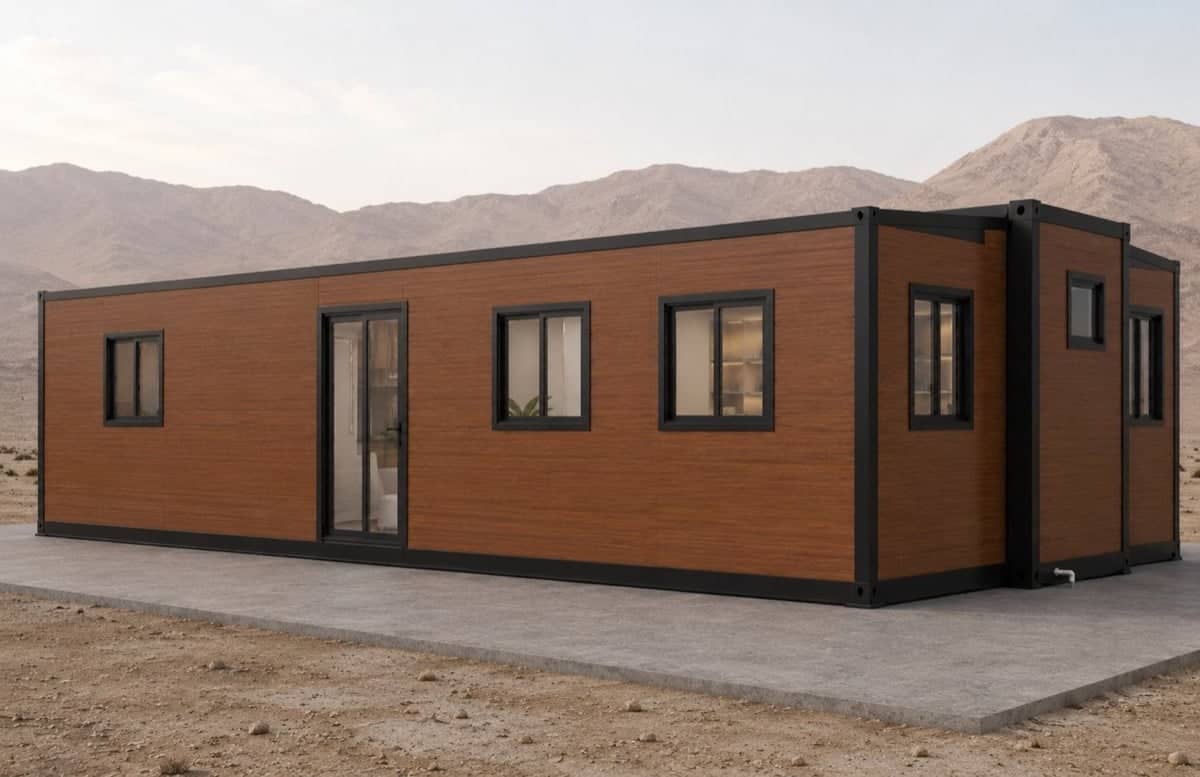
Container homes offer industrial aesthetics and structural rigidity. They can be cheaper per unit than a mobile home, but insulation, interior finishing and plumbing add up quickly. They also need planning permission when fixed to a foundation. As a tourist or glamping unit, a container can work well — as a permanent home, a park home or modular prefab is usually the more practical choice.
In planning terms, container homes sit in a grey area. A container resting on blocks that keeps its mobility is reversible but not exempt: it remains subject to prior control (in Portugal, a licence or a prior communication depending on the zone); one welded to a slab or set on permanent foundations is treated as a fixed building and follows the full regime, so always check with the local council before investing. Typical uses include a design studio in the garden, a temporary bar or restaurant, or a co-working space. Containers can also share a plot with mobile homes — a popular formula in tourism and commercial projects, with mobile homes as accommodation and containers as communal areas such as a reception or bar.
In summary
- Used mobile homes in our current stock start at £6,667 (median £26,625); a prefab house is priced per project, plus foundations and licensing.
- A mobile home from stock is the fastest to be ready; a prefab takes 3–12 months.
- A mobile home has a simpler, reversible planning route, not a permit-free one; a prefab always follows the full regime.
- A mobile home is relocatable and classified as movable; a prefab is fixed real estate.
- Choose mobile for speed, cost and flexibility; choose prefab for permanent residence and mortgage eligibility.
Frequently asked questions
Is a mobile home cheaper than a prefab house?
Usually, yes. In our current stock, used units (static caravans, mobile homes and chalets) start at £6,667 (median £26,625) and new units at £14,208 (median £86,167); a prefabricated house is priced per project and also needs a permanent foundation and, almost always, planning permission.
Do I need planning permission for a mobile home?
Usually, yes, if it is installed to stay on private land: being removable does not exempt it. In Portugal it needs a licence or a prior communication (comunicação prévia) under the RJUE, in Spain an urban planning licence (STS 1917/2024), and in France it may only stand on a campsite or PRL. On a licensed park, what the park's licence covers depends on the country — in Spain it does not replace the municipal licence. Always check with the local council.