Can you put a mobile home or static caravan on agricultural land in the UK?
By Matheus Agueda · 24 October 2026
The short answer
It depends on the use, and the council decides. In England and Wales planning permission is required for development (Town and Country Planning Act 1990, s.57(1)), which includes “the making of any material change in the use of any buildings or other land” (s.55(1)); using land for agriculture is not development (s.55(2)(e)). The legislation does not say in one sentence whether stationing a residential mobile home or static caravan on farmland is a material change of use, so that is for the council. A caravan site licence can only be issued where a planning permission for use as a caravan site, not granted by a development order, exists (Caravan Sites and Control of Development Act 1960, s.3(3)).
This post covers England first, then what differs in Scotland and Wales, not Northern Ireland. Sources were read on 24 October 2026. For sellers, see static caravans for sale in the UK, sellers compared.
The rules in brief:
- England and Wales: development (operations or a material change of use) needs permission (TCPA 1990, s.55(1), s.57(1)); agricultural use of land is not taken to involve development (s.55(2)(e)), and that text mentions no homes or caravans.
- A site licence needs planning permission (England, Scotland and Wales): a local authority may issue one “if, and only if” the applicant has a permission for use as a caravan site not granted by a development order (1960 Act, s.3(3)).
- No site licence is needed for a caravan incidental to a dwellinghouse (Sch. 1 para. 1), a stay of not more than two nights (para. 2), land of at least five acres within set limits (para. 3(1)) and seasonal accommodation for farm workers (para. 7).
- England, permitted development for paragraphs 2 to 10 of that Schedule, on condition that the use stops when those circumstances end and the caravans are removed as soon as reasonably practicable (GPDO 2015, Sch. 2 Pt. 5 Class A).
- England, general 28-day right: not permitted if the use is for siting any caravan, except a motor-vehicle caravan at a festival (Sch. 2 Pt. 4 Class B, B.1(c)).
- Enforcement time limits differ by nation: for operations and for change of use of a building to a single dwellinghouse, ten years in England, four in Wales (TCPA 1990, s.171B(1) and (2)) and four in Scotland (1997 Act, s.124); ten years for any other breach in all three.
Units available now


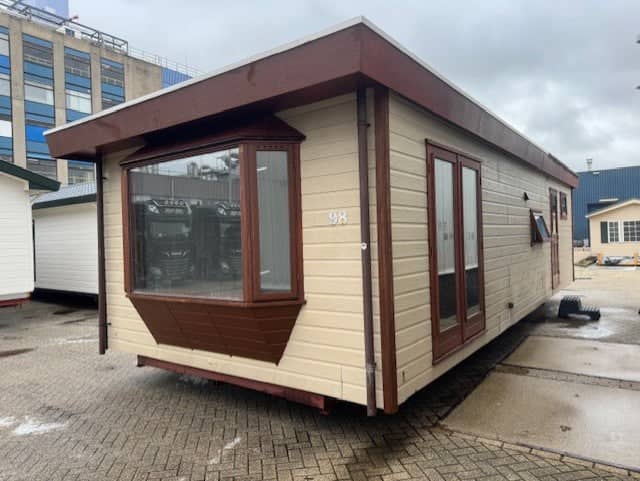
Mobile home or static caravan on agricultural land: the situations compared
| Situation | What the law requires | Source |
|---|---|---|
| Residential mobile home or static caravan on farmland (England and Wales) | Development needs permission and includes a material change of use; whether this is one is for the council | TCPA 1990, s.55(1), s.57(1) |
| Running a caravan site, holiday or residential | A site licence, issued only where planning permission exists; in England and Wales, using land as a caravan site without a required licence is an offence for the occupier | 1960 Act, ss.1(1), 1(2), 3(3) |
| Paragraphs 2 to 10 of Sch. 1 (England) | Permitted development; caravans removed when the circumstances end | GPDO 2015, Sch. 2 Pt. 5 Class A |
| 28 days a year use of land (England) | Not permitted if the use is for siting any caravan (festival motor caravan excepted) | GPDO 2015, Sch. 2 Pt. 4 Class B, B.1(c) |
| Farm building on a unit of 5 hectares or more (England) | Not permitted development if it would include a dwelling | GPDO 2015, Sch. 2 Pt. 6 Class A, A.1(c) |
What the legislation says: caravan and building
Caravan (all three nations). The 1960 Act defines a caravan as “any structure designed or adapted for human habitation which is capable of being moved from one place to another”, whether towed or transported on a motor vehicle or trailer. Railway rolling stock on rails and tents are excluded (s.29(1)).
Twin-unit homes. A structure “composed of not more than two sections separately constructed and designed to be assembled on a site by means of bolts, clamps or other devices” and physically capable, when assembled, of being moved from one place to another is not treated as not being a caravan only because it cannot lawfully be so moved (Caravan Sites Act 1968, s.13(1)). It is not a caravan for Part I of the 1960 Act if, assembled, it exceeds 20 metres in length, 6.8 metres in width or 3.05 metres in internal height of living accommodation (s.13(2)).
What the Acts do not say. For planning purposes a building “includes any structure or erection” (TCPA 1990, s.336(1), England and Wales), but the Acts do not say when a movable unit stops being a caravan and becomes a building, for example once it is fixed to the ground or connected to services. Wheels alone settle nothing: a tiny house on a trailer, a mobile home on a chassis and a unit on a foundation are a question of fact and degree for the local planning authority and, on appeal, the Planning Inspectorate and the courts. Ask the council in writing how it would treat your specific unit and base before you buy. The guide to transport costs for a mobile home explains how moving one works.
Short stays and temporary use
Site licence exemptions (licensing law). An occupier must not cause or permit land to be used as a caravan site unless they hold a site licence, subject to the Part I exemptions (1960 Act, s.1(1)). Schedule 1 gives, among others: a stay of “not more than two nights”, on conditions about other caravans and a 28-day count (para. 2); land of not less than five acres, with caravans stationed for habitation on no more than 28 days in the previous twelve months and no more than three at once (para. 3(1)); and agricultural land used “during a particular season” for people employed in farming operations on land in the same occupation (para. 7). Whether a plot qualifies depends on those facts.
Permission for a limited period (England and Wales). A council can grant permission subject to conditions “requiring the removal of any buildings or works authorised by the permission”, or the discontinuance of the authorised use, at the end of a specified period (TCPA 1990, s.72(1)(b)). English planning guidance refers, for new enterprises, to “whether it is appropriate to consider granting permission for a temporary dwelling for a trial period”.
Seasonal workers, farm buildings and permanent homes
English guidance says the need to accommodate seasonal workers “will generally not be sufficient to justify building isolated rural dwellings” (Planning Practice Guidance, Housing needs of different groups, paragraph 010). The agricultural permitted development right for farm buildings in England (Part 6 Class A, units of 5 hectares or more) is not available if the development would “consist of, or include, the erection, extension or alteration of a dwelling” (Sch. 2 Pt. 6 Class A, A.1(c)).
Where planning permission is needed, a council may grant it “either unconditionally or subject to such conditions as they think fit” (TCPA 1990, s.70(1)(a)) and must decide “in accordance with the plan unless material considerations indicate otherwise” (Planning and Compulsory Purchase Act 2004, s.38(6)). The Planning Portal (England) says applications have to be decided in line with the local planning authority’s development plan unless there is a very good reason not to. What is acceptable in the countryside, Green Belt, an Area of Outstanding Natural Beauty or a National Park is a matter for each authority’s local plan. The official texts give no general national rule for residential caravans on agricultural land beyond the licence-exempt cases.
National policy for isolated homes (England)
The National Planning Policy Framework (England, published 17 August 2026), policy HO11, says proposals for isolated homes in the countryside “should only be supported where one or more of the following circumstances apply”. The first is “an essential need for a rural worker, including those taking majority control of a farm business, to live permanently at or near their place of work” (HO11(1)(a)). The others are heritage enabling development, reuse of a redundant or disused building, subdivision of an existing residential building and exceptional design (HO11(1)(b) to (e)). Policy N2 also asks decisions to take into account the quality of agricultural land and, if significant development of agricultural land is necessary, to use areas of poorer quality land where possible (N2(1)(b)).
Holiday parks, residential parks and site licences
In England, a protected site is licensed land, not being land where the permission or site licence “is expressed to be granted for holiday use only” or bars caravans for human habitation at some times of year (Caravan Sites Act 1968, s.1(2)). The Mobile Homes Act 1983 (England and Wales) applies to an agreement to station a mobile home on a protected site and occupy it as the occupier’s only or main residence (s.1(1)).
A site licence can restrict “the occasions on which caravans are stationed on the land for the purposes of human habitation” or their number (1960 Act, s.5(1)(a)). The occupier applies to the local authority in whose area the land is situated (s.3(1)); to let units on your own farmland you need that planning permission first (s.3(3)), unless a Schedule 1 exemption applies. In Wales, the s.1(1) prohibition does not apply to a regulated site within the meaning of the Mobile Homes (Wales) Act 2013 (s.1(1A)).
What happens without permission
Carrying out development without the required planning permission, or failing to comply with a condition, “constitutes a breach of planning control” (TCPA 1990, s.171A(1)). The council may issue an enforcement notice where it appears there has been a breach and it is expedient to do so, having regard to the development plan and other material considerations (s.172(1)); English guidance confirms the council has discretion, and says a stop notice may not prohibit the use of a building as a dwelling house but may prohibit the use of land as a site for a caravan occupied as a person’s own main residence. In England and Wales, using land as a caravan site without a required licence is separately an offence for the occupier (1960 Act, s.1(2)).
The time limits in s.171B (England and Wales):
- Operations: ten years from substantial completion in England, four years in Wales (s.171B(1)).
- Change of use of a building to a single dwellinghouse: ten years from the breach in England, four in Wales (s.171B(2)).
- Any other breach: ten years from the date of the breach (s.171B(3)).
The quoted texts do not say which of these applies to a caravan stationed on land, and the English and Welsh periods differ for the first two, so ask the council in writing. English guidance says that for breaches on or after 25 April 2024 operational development and an unauthorised change of use to a single dwellinghouse become immune after 10 years; earlier breaches follow transitional rules we do not summarise.
Scotland and Wales
Wales. Enforcement is limited to four years (ten in England) for operations and for change of use of a building to a single dwellinghouse (TCPA 1990, s.171B(1) and (2)). Planning Policy Wales treats rural enterprise dwellings as “one of the few circumstances in which isolated new residential development in the open countryside may be justified” and says an occupancy condition must be applied (paras 4.2.37 and 4.2.38). Agricultural land of grades 1, 2 and 3a is the best and most versatile and “should only be developed if there is an overriding need” (para. 3.58).
Scotland. Part I of the 1960 Act (site licences and exemptions) extends to Scotland, but planning is under the Town and Country Planning (Scotland) Act 1997, whose permission provisions are not quoted here. Enforcement is barred after four years for unauthorised operations and for a change of use of a building to a single dwellinghouse, and after ten years for any other breach (s.124(1) to (3)). Decisions follow the development plan unless material considerations indicate otherwise (s.25(1)). The Scottish 28-day right (GPDO (Scotland) 1992, Class 15) excepts use as a caravan site. National Planning Framework 4, Policy 17(a), supports new homes in rural areas where its criteria are met, including a home “demonstrated to be necessary to support the sustainable management of a viable rural business or croft” with an essential need for a worker to live near their work. We found no official Scottish text on caravans on agricultural land beyond these.
Before you buy the land: what to ask the council in writing
The local planning authority decides the planning question (in Wales, the county council or county borough council: TCPA 1990, s.1(1B)), and the local authority in whose area the land is situated issues site licences. Ask for a written answer and keep it.
- Is stationing this unit on this plot a material change of use? Describe the unit (its type and size) and the use (home, holiday let or seasonal worker accommodation).
- Which local plan policies apply? Ask about Green Belt, Area of Outstanding Natural Beauty, National Park and agricultural land.
- Does a licence-exempt case or the England permitted development right apply? Give the acreage, the season, the number of caravans and the days of use.
- Would a site licence be needed, and on what conditions?
- Would a limited-period permission or an occupancy condition be considered?
This is general information, not legal advice; your plot’s facts and your council’s policies decide the answer.
Which units to choose for agricultural land or your own plot
If the council says no, or only for a limited period, a unit on a chassis keeps the option of moving it. Green Village Mobile Homes sells new and used mobile homes, tiny houses and modular and container homes, and delivers to the United Kingdom.
| Unit type | Lowest price delivered to the United Kingdom | Where to see them |
|---|---|---|
| Tiny house | £8,125 | tiny houses |
| Used mobile homes | £6,667 | used mobile homes |
| New mobile homes | £14,208 | new mobile homes |
Green Village sells homes that already exist, in stock, each with its own listing, photos and the delivered price for the destination you choose. VAT is charged separately. Each listing shows the delivered price for 18 destinations, the United Kingdom among them; for any other country Green Village sends a quote. Transport is organised by Mobile Home Logistic, included in the price and insured for 100 % of the home’s value. Green Village has 5 stores in 4 countries, with the main store in Maia (Portugal). For homes delivered to your area see mobile homes in the United Kingdom, and before you buy the land or the unit, contact us with the planning question you plan to put to the council.
Frequently asked questions
Can you put a mobile home on agricultural land in the UK? It depends on the use and the council decides. In England and Wales development needs planning permission (TCPA 1990, s.57(1)), but the legislation does not say in one sentence whether a residential caravan on farmland is a material change of use (s.55(1)). A site licence can be issued only where a planning permission for use as a caravan site, not granted by a development order, exists (1960 Act, s.3(3)).
Do I need planning permission for a static caravan on a field? Whether stationing a caravan for habitation is a material change of use is a question for the council. In England, use as a caravan site in the licence-exempt circumstances of Sch. 1 paras 2 to 10 is permitted development, with the caravans removed when those circumstances end (GPDO 2015, Sch. 2 Pt. 5 Class A). In Scotland, ask the planning authority.
Can I put a caravan on my land for 28 days without permission? Not under the general 28-day right: in England it is not permitted if the use is for siting any caravan, apart from a motor-vehicle caravan at a festival (Sch. 2 Pt. 4 Class B, B.1(c)). Wales has the same exclusion from 1 September 2026 (GPDO 1995, Sch. 2 Pt. 4 Class B, B.1(b)), and the Scottish Class 15 excepts use as a caravan site.
What happens if I station a mobile home without permission? Development without the required permission is a breach of planning control (s.171A(1)), and the council may issue an enforcement notice (s.172(1)). The time limits are in s.171B: for operations and for a change of use of a building to a single dwellinghouse, ten years in England and four in Wales; for any other breach, ten years. The quoted texts do not say which applies to a caravan on land, so ask the council. In Scotland the limits are in s.124 of the 1997 Act.
How much does a mobile home for agricultural land cost? In the Green Village catalogue, tiny houses start from £8,125, used mobile homes from £6,667 and new mobile homes from £14,208, delivered to the United Kingdom, with VAT charged separately.
Sources
- Caravan Sites and Control of Development Act 1960, s.1
- Caravan Sites and Control of Development Act 1960, s.3
- Caravan Sites and Control of Development Act 1960, s.5
- Caravan Sites and Control of Development Act 1960, s.29
- Caravan Sites and Control of Development Act 1960, Schedule 1
- Caravan Sites Act 1968, s.1
- Caravan Sites Act 1968, s.13
- Mobile Homes Act 1983, s.1
- Town and Country Planning Act 1990, s.1
- Town and Country Planning Act 1990, s.55
- Town and Country Planning Act 1990, s.57
- Town and Country Planning Act 1990, s.70
- Town and Country Planning Act 1990, s.72
- Town and Country Planning Act 1990, s.171A
- Town and Country Planning Act 1990, s.171B
- Town and Country Planning Act 1990, s.172
- Town and Country Planning Act 1990, s.336
- Planning and Compulsory Purchase Act 2004, s.38
- Town and Country Planning (Scotland) Act 1997, s.25
- Town and Country Planning (Scotland) Act 1997, s.124
- GPDO 2015 (England), Schedule 2 Part 4
- GPDO 2015 (England), Schedule 2 Part 5
- GPDO 2015 (England), Schedule 2 Part 6
- GPDO 1995 (Wales), Schedule 2 Part 4
- GPDO (Scotland) 1992, Schedule 1
- NPPF, chapter 6 (HO1-13)
- NPPF, chapter 19 (N1-6)
- National Planning Framework 4, Policy 17
- Planning Policy Wales, Edition 12
- Planning Practice Guidance, Housing needs of different groups
- Planning Practice Guidance, Ensuring effective enforcement
- Planning Portal, the decision-making process